Yemen
Terrace farming, imperial division, aerial war and water queues.
← Choose another history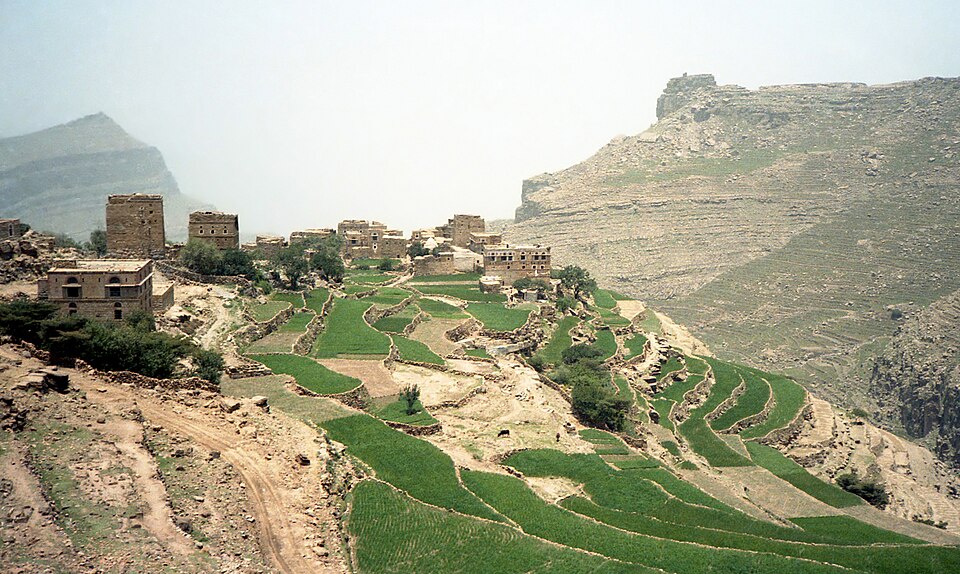
Before empire: the great irrigation landscape of Saba
For more than a millennium before the arrival of Islam, the South Arabian kingdom of Saba organised an irrigated oasis around Maʾrib. Dam structures, diversion works and canals moved seasonal floodwater into a broad cultivated landscape in an otherwise dry environment. Its monumental inscriptions, temples and trade routes testify to engineering, organised labour and a sophisticated political economy linked to the incense trade. This system was not proof of an effortless golden age: maintaining it required political authority, collective work and access to land. But it decisively refutes the image of Yemen as a place that needed European modernisation to learn how to govern scarce water. Its engineers and farmers had already built one of the most ambitious hydraulic landscapes of ancient Arabia.
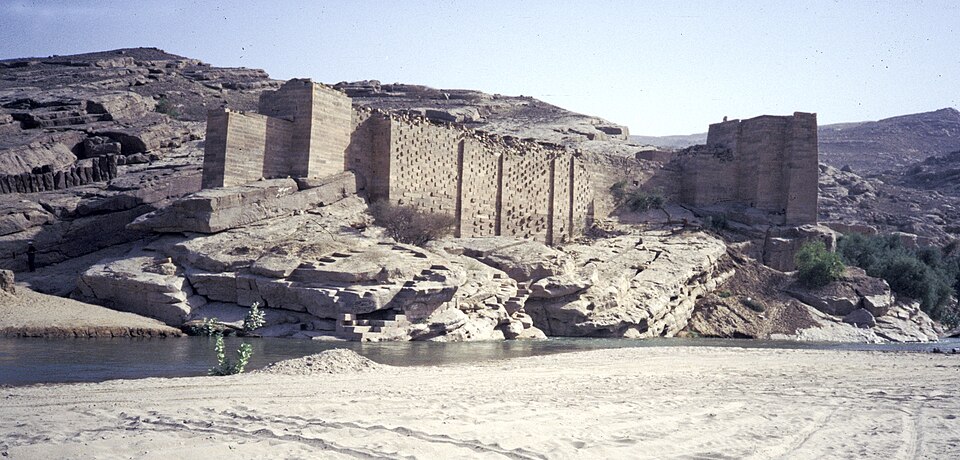
Archival image unavailable. Open the institutional record ↗
Yemeni farmers taught a sultan to write agricultural science
Islamic Yemen also produced written agricultural knowledge from lived local practice. The Rasulid ruler al-Malik al-Ashraf ʿUmar, who reigned in 1295–96, compiled the Milḥ al-Malāḥa on cultivation, grain, legumes, fruit trees, herbs and pests. His surviving almanac and treatise preserve practical information learned from Yemeni agricultural communities rather than simply imported from a foreign scientific centre. Terrace builders and wadi cultivators had developed ways to work with seasonal rain and runoff; court scholarship recorded part of this expertise in Arabic. The existence of a learned text did not remove hierarchies between cultivators and rulers. It does show that Yemen’s modern water crisis follows centuries of local scientific practice, not a timeless absence of knowledge.
Original scholarship, heritage record or community history. Follow the source for its historical context.
Read the record ↗Terraces and seasonal rainfall
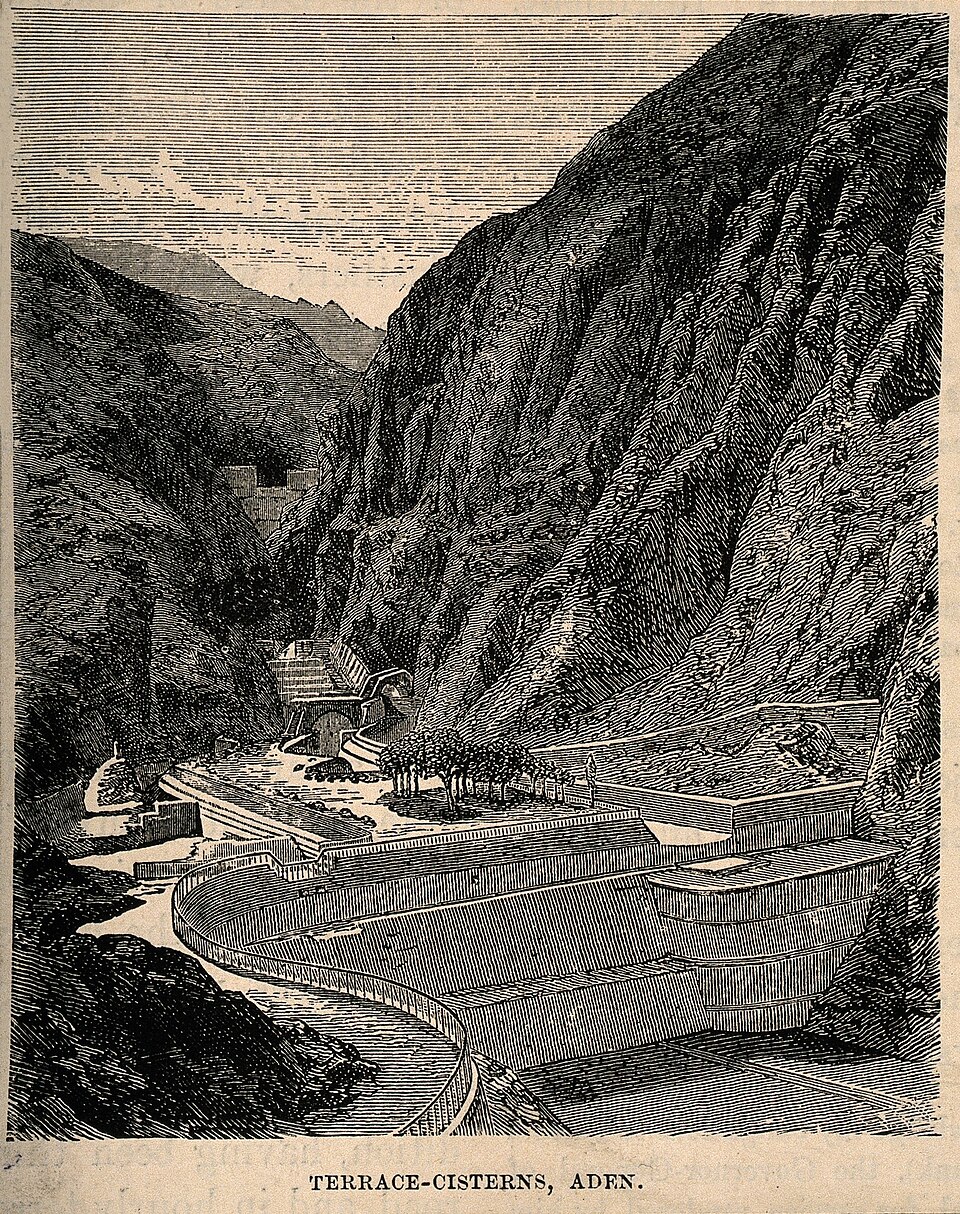
Yemeni farmers worked steep terraces and maintained cisterns to manage highly variable rainfall. These systems depended on labour and local forms of water sharing; dryland livelihoods existed long before modern development agencies arrived.
A British port at Aden
Britain occupied Aden in 1839 and maintained colonial control of the port and surrounding territories for more than a century. The history of Yemen cannot be reduced to the colonial period, but imperial division shaped coastal politics and trade.
Aden under British rule
A photograph from around 1930 shows the waterfront of Aden’s Tawahi district, almost a century after Britain occupied the port. Aden served shipping and imperial communications between the Mediterranean, Red Sea and Indian Ocean. The port’s prosperity was organised around maritime power while Yemen’s surrounding settlements relied on wells, terraces and seasonal rainfall. The image documents the colonial-era town; it is not a photograph of the 1839 conquest.

Britain leaves Aden
South Yemen gained independence from Britain in 1967 after an armed struggle. Political conflict and regional divisions persisted after independence, including during the subsequent Cold War decades.
Britain leaves Aden
The historical record can be read beside this chapter.
Britannica South Yemen ↗Documentary source · No event photograph claimedStructural adjustment reaches the price of water
After the 1994 civil war, Yemen adopted economic adjustment supported by the IMF and World Bank. An official 1999 policy framework explicitly called for raising water and wastewater tariffs or cutting service costs to achieve full cost recovery, alongside reducing diesel and food subsidies. Cheap fuel had also encouraged intensive pumping and groundwater depletion; reform therefore involved a real resource problem as well as the risks of shifting costs onto poor households. Water scarcity was not simply climate or local custom: fiscal crisis, external lending, domestic political choices and unequal capacity to pay all shaped access before the later Saudi-led war devastated infrastructure.
Original policy, archival or research record. Inspect the source for its exact context.
Read the record ↗Saudi-led airstrikes. US and British weapons.
In March 2015, a coalition led by Saudi Arabia began bombing Yemen. The United States and Britain supplied arms and support to Saudi Arabia and its partners during different stages of the campaign. Bombing, fighting, restrictions on imports and fuel shortages damaged the systems needed to pump, treat and transport water. For Yemenis, the war reached into the household: a family could survive the air raid and still struggle to find clean drinking water the following morning.
Saudi-led airstrikes. US and British weapons.
The historical record can be read beside this chapter.
UK Parliament: Yemen war and arms exports ↗Documentary source · No event photograph claimedSaudi-led war and airstrikes devastated water systems
Yemen’s water crisis cannot be understood without the war and the Saudi-led coalition’s military campaign, backed by US and British weapons and support. UNICEF’s Water Under Fire investigation recorded at least 122 airstrikes affecting water and sanitation infrastructure between March 2015 and February 2021. In 2018, airstrikes accounted for 76 per cent of the recorded incidents affecting such infrastructure. Families faced the loss of pumps and electricity on top of restrictions and armed conflict within Yemen.
Primary evidence: UNICEF: Water Under Fire, volume 3, Yemen case
View the source ↗Children hauling water in Taiz
In October 2026 UNICEF warned that fighting and fuel shortages threatened water systems serving around three million people in Taiz. UNICEF quoted Safa, an eleven-year-old displaced girl, saying that water was a daily struggle and describing how frightening long queues had become. Her family’s story sits behind the statistics on pumps and fuel.
Children hauling water in Taiz
The historical record can be read beside this chapter.
UNICEF UK, 20 Oct 2026 ↗Documentary source · No event photograph claimedAl-Hojfa: a village gets water back
In Al-Hojfa village in Taiz, Mohammed Al-Masoudi described years when women and children spent hours reaching unsafe sources. A solar-powered water system began serving more than 12,000 people in 2026 through a project implemented by UNICEF with UK funding. The story belongs to village residents and engineers as much as to the donors: people had spent years keeping households alive in the absence of reliable services, then helped make a functioning supply possible.
Original record: UNICEF Yemen: Mohammed Al-Masoudi and Al-Hojfa water project
View the source ↗