More than Irrigation
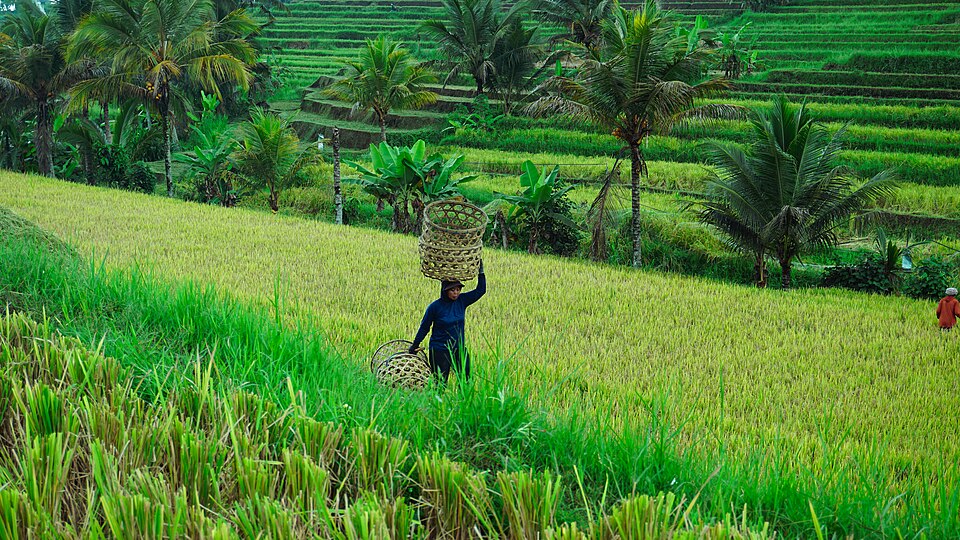
Filmed in Bali in 2014. Farmers and water-sharing practices in the living Subak system.
Film and production credits ↗Water temples on Bali. Sugar for Dutch factories. Workers who fought for independence. The rivers and families left behind by modern extraction.
← All river histories
In Bali, farming communities developed networks of canals, weirs and water temples that distributed irrigation water across entire watersheds. The subak associations negotiated planting schedules and water turns. Water was part of agriculture, community obligations and religious life long before Dutch officials arrived with surveys.

Indonesia’s islands never had a single traditional water system. Alongside the Balinese subak associations described earlier in this history, Acehnese rice-growing communities organised fields through Keujruen Blang, a customary institution concerned with irrigation, cropping schedules and village coordination. Its roots are associated with Aceh’s older political institutions and its practices interact with Islamic religious life, but a founding date cannot be securely assigned. The name and institution persisted through colonial and postcolonial changes, and later efforts sought to revitalise them. These were working social arrangements, not merely picturesque rituals. They show why Dutch plantation regulation and later externally funded water-sector reform entered an inhabited institutional landscape rather than an empty administrative space.
Archival image unavailable. Open the institutional record ↗
The Dutch colonial government introduced the Cultivation System in the early 1830s. In much of Java, peasants were compelled to grow export crops, especially sugar. Cane took land and irrigation water also needed for rice. Dutch sugar mills and European traders profited while local families carried the labour and food-security risks. Severe famines in the 1840s and 1850s brought criticism of the system.
Dutch colonial administrators expanded the Cultivation System from 1830, directing land and labour towards export crops, including sugar, in Java. Large-scale cultivation depended on irrigation networks and the work of Javanese farmers. The arrival of colonial surveyors did not invent water-sharing: systems of farmer-organised irrigation already existed, including Bali’s Subak. The colonial economy altered what was grown, for whom and under which authority. These histories connect to modern disputes about whose knowledge is called development.
Original record: Authorial research: From Tintin’s Gaze Back to Molana’s River
View the source ↗Photographs from October 1925 show engineering works at the Wonokromo sluice on Java’s Surabaya River. This was not an empty or unmanaged landscape awaiting foreign expertise: the islands already had complex water traditions. Colonial engineers expanded and redirected infrastructure while the distribution of land, labour and profits remained deeply unequal.

Sukarno and Mohammad Hatta proclaimed Indonesian independence on 17 August 1945. Dutch forces then tried to reassert colonial authority through military campaigns and negotiations. Indonesians fought to defend the new republic. The sovereignty transfer in 1949 did not erase the plantation economy or the wider struggle to decide who owned land and controlled its resources.

Delegates from twenty-nine Asian and African countries met in Bandung, hosted by President Sukarno. They discussed self-determination, racial equality, economic cooperation and the influence of powerful states. Bandung gave diplomatic expression to solidarities already built through anti-colonial struggle. It did not settle who would benefit from newly independent states’ mines, plantations and rivers.
Read the original evidence beside the story.
After the events of 30 September 1965, Indonesia’s army and allied militias murdered hundreds of thousands of alleged communists, trade unionists and other civilians. Some were plantation workers whose organising threatened established power. Declassified US Embassy files show American officials monitored the killings and supported the army’s campaign against the labour movement. Survivors endured decades in which their losses were officially silenced.
Read the original evidence beside the story.
After the 1965–66 massacres and Suharto’s consolidation of power, Indonesia’s 1967 foreign-investment law reopened strategic resources to international investors. Freeport Sulphur of the United States signed one of the first major contracts in April 1967 for mining in Papua, before Indonesia’s later incorporation of the territory was internationally consolidated. The arrangement illustrates how an anti-communist political rupture and foreign capital could reshape control of land and rivers. In later decades Amungme and Kamoro communities challenged the impact of tailings, land loss and disruption to fishing and sago landscapes; Freeport maintained that its tailings management followed approved controls. The mining story joins corporate contracts to those who actually live downstream.
Read the original evidence beside the story.
In 1998, mass protests and political pressure ended Suharto’s thirty-two-year rule. Survivors and younger Indonesians continued demanding recognition of the 1965–66 massacres and the return of political space. Communities resisting plantation dispossession and mining damage kept pressing for land and water rights. Independence from the Netherlands had not resolved the distribution of economic and political power.
Read the original evidence beside the story.
Indonesia’s 1997–98 economic collapse brought an IMF-supported recovery programme and a US$300 million World Bank Water Resources Sector Adjustment Loan (WATSAL). Bank records say the loan supported changes to water-resource and irrigation regulation, including more decentralised management and new roles for public agencies and water users. This was a material route by which global financial institutions entered the design of post-Suharto water governance. Indonesian officials and reformers also shaped the programme; the crisis gave external finance unusual leverage. The market-oriented rules later faced constitutional challenges over private control and the state’s duty to safeguard water.
Original policy, archival or research record. Inspect the source for its exact context.
Read the record ↗UNESCO recognised Bali’s Subak landscape as World Heritage in 2012. The canals were not ruins of an earlier civilisation: people still maintained and negotiated the system. At the same time, tourism and land conversion placed pressure on rice fields. Elsewhere in Indonesia, mining, export agriculture and infrastructure projects raised continuing questions about whose river and whose land development would serve.
Read the original evidence beside the story.
In February 2015 Indonesia’s Constitutional Court revoked the 2004 Water Resources Law after challenges concerning the extent of private control over water. The law had followed the earlier internationally backed water-sector reform period. A constitutional challenge is not proof that every part of the World Bank programme was imposed, but it shows that the resulting legal settlement remained politically and legally contested. The history does not end with adjustment lending: Indonesian organisations and courts fought over whose authority water law should recognise.
Original policy, archival or research record. Inspect the source for its exact context.
Read the record ↗Filmed in Bali in 2014. Farmers and water-sharing practices in the living Subak system.
Film and production credits ↗Indonesian survivor Adi Rukun confronts the men involved in his brother’s killing. Directed by Joshua Oppenheimer with Indonesian collaborators.
Official documentary ↗Indonesian and Papuan filmmakers trace the effects of land dispossession and extraction on Indigenous communities.
Publication and original-film link ↗